Instant mirroring
The presenting machine broadcasts each slide change; the others move to the same position immediately. No perceptible delay for the audience.

Multilingual slide synchronization keeps every language version of a presentation on the same slide. The speaker advances the deck once and every room, screen and interpreter booth follows instantly — over your local network, with no internet dependency and nobody clicking along by hand.
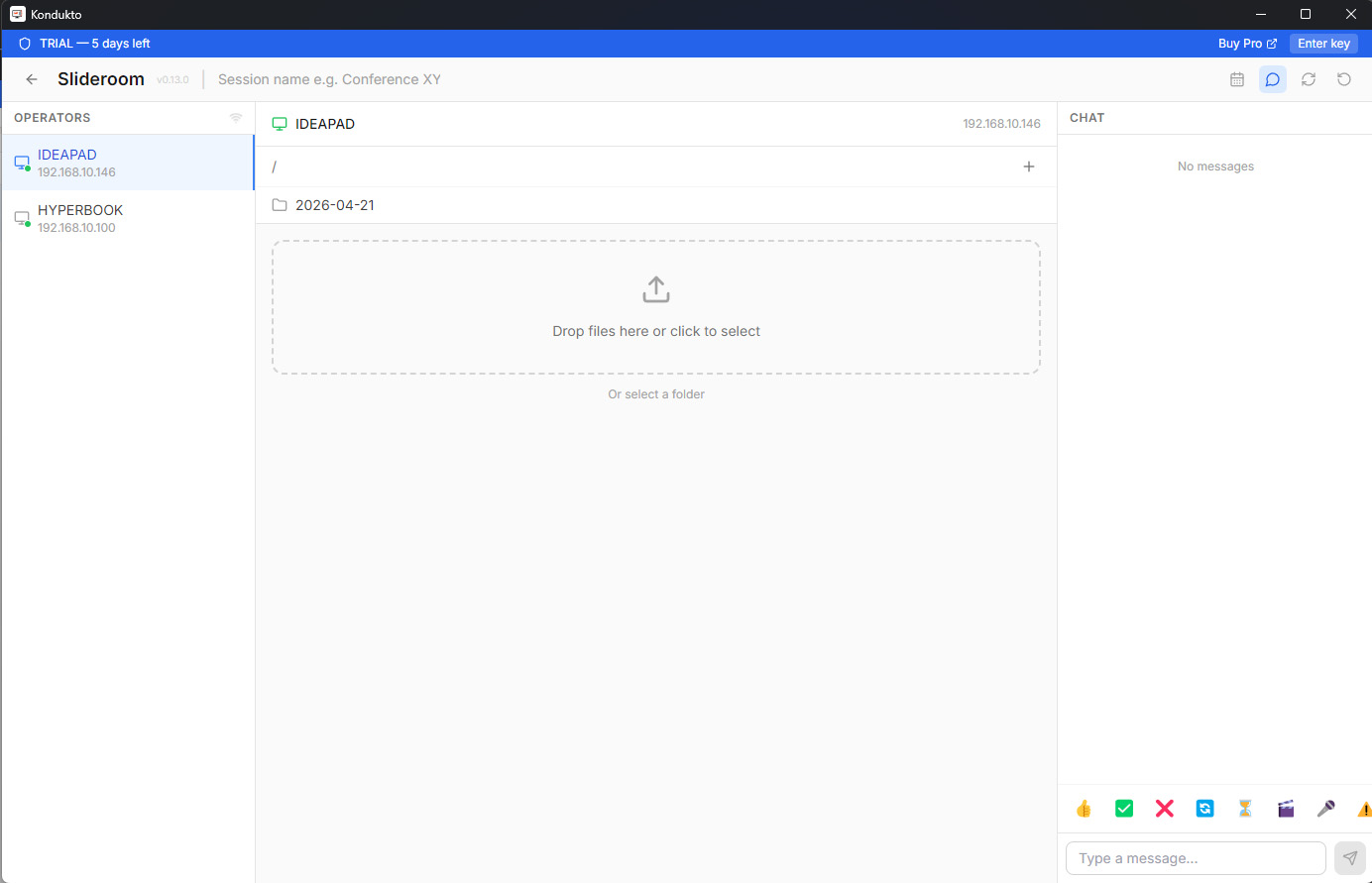
KonduktoPILOT links the machines driving each language version and mirrors every slide change between them.
The presenting machine broadcasts each slide change; the others move to the same position immediately. No perceptible delay for the audience.
Each room or booth runs its own translated deck on its own computer. Windows and macOS mix freely in the same session.
Synchronization travels over the venue LAN. It keeps working when the conference Wi-Fi does not, and no slide ever leaves the building.
Multilingual congresses, EU institution meetings, medical and scientific conferences, and any event with simultaneous interpretation share the same problem: the same presentation runs in parallel in several versions, and they drift apart. Someone in the second room clicks a beat late, the interpreter is left describing a slide the audience cannot see, and the whole session feels sloppy.
Slide synchronization removes that failure mode completely. Interpreters in the booth always have in front of them the exact slide the speaker is talking about, which matters enormously when the deck carries data, charts or terminology they need to render live. Audiences in every room read the content in their own language, in step with the stage.
Without synchronization, someone has to sit in each secondary room and advance slides by hand while watching a feed of the main stage. It works for ten minutes. Then attention slips, a speaker skips two slides, or a question sends the deck backwards — and the versions diverge with no reliable way to recover mid-talk. On a full conference day, across several parallel tracks, that approach costs both staff and credibility.
Automating it also frees your crew. The people who were clicking along can run the actual show instead, and you no longer need an extra operator per language just to keep decks aligned.
Every language version needs its own machine running KonduktoPILOT on the same network, each holding its translated deck. Keep the slide order identical across translations — matching is positional. The presenting machine drives the session; the rest follow. There is no server to configure, no IP addresses to type and no installer to push through IT: the applications discover each other on the LAN. If some machines cannot share a local network, optional Global mode connects them over the internet through an encrypted relay instead.
Slide synchronization is one module of the wider Kondukto conference toolkit, so it fits alongside collecting presentations from speakers and distributing files to operators over LAN. Behind all of it stands AS LIVE MEDIA, an AV company that runs conferences technically — which is why the workflow is shaped by real show days rather than a feature list. When you need it, we can support your event remotely or be there on site.
One speaker advances the deck and every other language version moves to the matching slide at the same moment. Each room and every interpreter booth sees the correct slide in its own language, without anyone clicking manually.
Yes. Synchronization runs across multiple machines on the same network and mixes Windows and macOS freely, so every room and booth can use whatever hardware it already has.
No. Slide synchronization runs over your local network, which is why it keeps working when venue Wi-Fi does not. An optional Global mode exists if machines are on separate networks.
No. The speaker presents exactly as usual — with a clicker or the keyboard. Synchronization happens in the background and can be combined with a presentation remote.
Slides are matched by position in the deck, so translated decks should follow the same slide order. Keeping the structure identical across languages is the one preparation step that matters.
There is no fixed limit built into the workflow — the practical limit is your network and the number of operator machines you set up. Multi-room congresses with several parallel language feeds are the typical use case.